Why does visualization matter in times of crisis and volatility? Here’s everything you need to know about the business case for visualization in B2B, teams, strategy, and leadership: :
- Visualization creates stability: Particularly in times of crisis, visualization brings inner calm, focus, and orientation — for individuals, teams, and entire organizations.
- Problem-solving made easy: Complex challenges become clear and understandable through visualization, making fast, well-grounded decisions possible.
- Clarity for major undertakings: For ambitious projects, transformations, and change initiatives, visualization is the key to engaging and inspiring everyone involved.
- Lasting understanding: Visualization speaks to both the mind and the heart, anchors knowledge for the long term, and fosters genuine shared understanding.
- Impact in any situation: Whether in meetings, workshops, while learning, or on your own — visualization supports communication, learning, and personal development.
- Brain-friendly and effective: Drawing by hand activates central regions of the brain, improves memory and concentration, and encourages creative ways of solving problems.
- A success factor for organizations: Visualization is not a nice-to-have — it can become a decisive success factor and a stabilizing element in uncertain times.
Visualization as a Stability Factor
Especially in times of crisis, economic difficulty, or disruptive change, what people lack most is one thing: stability.
The inner calm needed to make good decisions, to act with foresight, and to integrate many perspectives (instead of falling for the loudest opinion in the room) rests on this stability.
A clear inner picture helps with that. But how quickly does it fade — slipping out of mind, drowned out by thoughts, emotions, and news? This is exactly where visualization comes in.
When you have a visualization of your vision, goals, wishes, or projects, the overview is back. The next steps come back into focus. Long-term direction isn’t lost — whether on a personal level, as a team, or as an entire organization. A visualization provides stability.
Visualization as a Problem-Solving Tool
Imagine you have lost the overview. Either everything is too much (you can’t see the forest for the trees), or too complex (you’re standing in dense fog), or too complicated (you’re swimming in a sea of details).
In each of these cases, you need to help yourself quickly — to use your own resources to regain perspective. Here is how the brain works: whatever happened most recently in time, or whatever screams loudest for attention, seems to be the most important. Which, of course, is completely wrong.
Because that small detail that came up, say, two and a half days ago in the morning and is now scribbled on a tiny sticky note may turn out to be the decisive piece of information. In other words, the pure chronology of events, thoughts, or emotions rushing past can be incredibly misleading. Using images and visualization helps exactly here.
A short how-to as a quick problem-solving tool:
- Any sheet of paper will do, and any pen.
- If you don’t know where to start, start in the middle. Otherwise go from left to right, with space above and below.
- Write down terms, thoughts, inspirations. On the left, more past-oriented entries — numbers, data, facts. On the right, more future-oriented ones — what’s new, ideas, where things could develop.
- If you like, find small symbols for the words. In any case, connect the dots. Use lines, arrows, and movement.
- Sense the underlying energetic direction and the movement from problem to solution, and draw that in too.
- Enjoy the clarity.
A second reason this works lies, again, in the brain..

The Business Case: Where is Visualization Worth It? On Truly Big Undertakings
Content
ToggleVisualization is either used exclusively as the primary method or added in a targeted way as a supporting element. Especially when something really matters — when ambitious projects or important goals are on the line — visualization unfolds its full impact. It makes complex undertakings tangible and supports the successful realization of ambitious projects.
Visualization is worth it:
- When it is about implementation.
- Wherever many — including contradictory — perspectives are needed to create solutions.
- When it is hard for those involved to picture a target state or a transformation.
- When overload needs to be avoided.
- When classic methods might fail or have not worked in the past (text documents, PowerPoint, etc.).
- When a pilot group has developed something genuinely new and now needs to reach many more people (e.g., employees or customers).
- When emotion or the subconscious need to be touched in order to achieve something or bring something new into being.
- For so-called “wicked problems.”
It is precisely in these areas that we at VISUAL FACILITATORS go to work for our clients.
Why Is Visualization Worth It? Case Study: “Factory of the Future”

A standout example of why visualization pays off is the case study “Factory of the Future” (German). A consulting agency was supporting an automotive supplier with an innovative large-scale project. Instead of abstract architectural models, a strategic target picture was developed jointly with VISUAL FACILITATORS.
This visualization made it possible to convey the overall concept and the new interaction between people and technology in an emotional and understandable way. The target picture created clarity, convinced the executive board, and anchored the vision with everyone involved. The result: the new production facility was built exactly as shown in the target picture – a real success factor.
When Is Visualization Worth It?
- When people get together (meetings, workshops)
- While learning
- Even on your own: getting clear on your thoughts and plans
Visualization unfolds its impact in many situations. Especially when people come together in meetings or workshops, it makes sure that complex correlations become understandable and accessible. In a learning context, too, visualization helps to anchor knowledge for the long term and make connections visible.
But visualization is a valuable tool not only in groups — it serves individuals too. Anyone who puts thoughts, goals, and plans on paper creates clarity and structure. That makes visualization a universal key to better communication, more effective learning, and personal growth — both as a team and on your own.
Why Does It Work?
Why are drawing by hand and writing by hand with pen and paper so much more powerful than any activity on screens of any kind? Once again, the marvels of the active brain come into play:
- Motor activity activates the brain: When you draw by hand, you activate not only the visual areas but also the motor regions of the brain. This sensorimotor connection significantly strengthens memory formation.
- The RAS (reticular activating system): Drawing by hand activates the RAS – a network in the brainstem that decides which information is important. Anything you create with your hand is automatically classified as “important” and stored more effectively.
- Slowness as an advantage: The physical slowness of drawing forces your brain to focus.
- Focusing: You can’t quickly “copy-paste” – every stroke is conscious and deliberate.
Why Pen and Paper Are Especially Effective
- Haptic feedback: The feel of pen on paper, the resistance, the texture — all of this sends additional sensory signals to the brain. This multisensory experience strengthens memory.
- Spatial orientation: On paper, you have a physical map of your thoughts. Your brain can remember where information was located (“That was in the upper left”). Digitally, this spatial anchoring is missing.
- No digital stress: No notifications, no Zoom, no technical distractions. Your brain can focus fully on the creative process.
The Neurobiological Process
What is at work here is, in effect, an enhanced learning network. Visualization or drawing by hand simultaneously activates the visual cortex (seeing), the motor cortex (movement), the prefrontal cortex (planning), and the hippocampus (memory). This produces:
- Dopamine release: Completing a drawing releases reward hormones. That motivates and emotionally reinforces what was learned.
- Theta waves: During creative drawing, the brain produces theta waves — the same brain waves as during deep meditation. This fosters insights and aha moments.
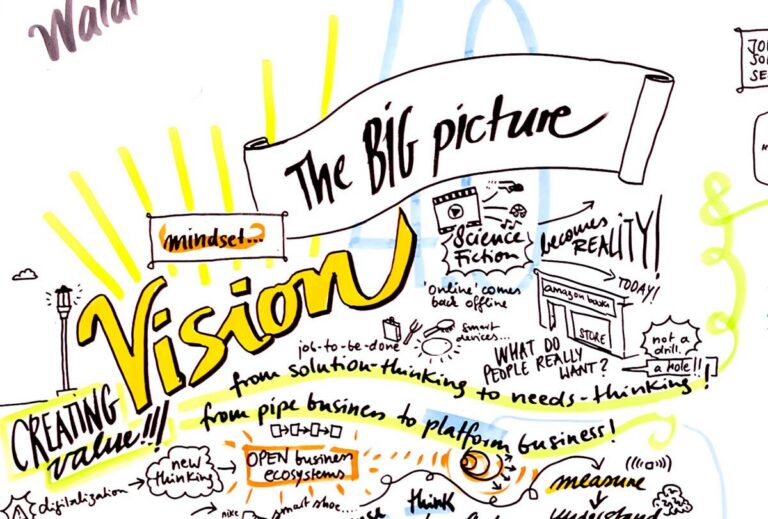
Detail of a Strategic Visualization
The Overview Effect
When you put your thoughts on paper, you externalize them. Your brain no longer has to “keep them in mind,” which frees up capacity for new connections and insights. This is also why journaling is so effective and supports personal growth.
On paper, you see connections that remained mentally invisible. The brain is wired to recognize visual patterns – far better than abstract mental constructs.
The feeling that everything is “under control” (because it’s visible on paper) reduces cortisol and improves cognitive performance. In other words: it reduces stress. This is why a hand-drawn strategy picture is so powerful: it leverages all of these neurological mechanisms at once and thereby creates lasting understanding instead of superficial consumption.
What Is the Main Obstacle? (And How Easy Is It to Overcome?)
- What usually gets in the way is the belief “I can’t draw.”
- This often comes from the school system. Children frequently doodle in class (because the brain learns better that way — see above), and the teacher then says, “Stop that and listen to me.” This stops the drawing so thoroughly that today almost everyone says, “I can’t draw.”
- Once that belief is dissolved, the simple, effortless use of pen and paper becomes available — to boost problem-solving skills, leadership ability, learning, and personal development.
When Is Visualization Not Worth It?
Visualization should not be confused with:
- Art or illustration. The use described here refers to business, change projects, processes, and vision work.
- Pretty pictures. Think of a trainer working with a group. The group doesn’t understand something. The trainer quickly draws something barely recognizable on a flipchart. Now the group gets it — something has clicked. What can the trainer do with the flipchart? Throw it away immediately. Because it was about understanding, not about the picture.
Conclusion: Visualization Is the Key to Lasting Success
Visualization is not a nice-to-have. It can be the decisive success factor — the stabilizing element in turbulent times. It creates clarity, orientation, and engagement where uncertainty and complexity prevail.
Especially in major undertakings, in change initiatives, or in crisis situations, visualization gives teams and leaders something to hold on to, fosters shared understanding, and makes it easier to deliver on demanding goals. It helps to integrate perspectives, accelerate decisions, and embed lasting solutions. That makes visualization a central tool for transformation, innovation, and entrepreneurial progress – especially in the age of AI.

Create Brain-Friendly Clarity Now — With VISUAL FACILITATORS at Your Side
Use the power of visualization to lead your organization through challenging times and shape lasting change. VISUAL FACILITATORS helps you make complex topics understandable, anchor your initiatives in vivid imagery, and truly bring everyone along. Whether strategy, transformation, or team processes — our experienced team supports you from the very first idea to successful implementation. Discover that visualization is a success factor!
FAQ
Visualization creates stability and clarity when uncertainty and complexity dominate. It helps teams and leaders keep the overview and make better decisions.
Visualization shows its impact in major undertakings, in meetings, workshops, and during learning. Individuals also benefit when they want to give clear structure to their thoughts and plans.
Visualization makes complex relationships quickly understandable and emotionally tangible. It speaks not only to the mind but also to the heart, and supports lasting understanding.
VISUAL FACILITATORS guides you from clarifying goals through developing tailored visualizations all the way to successful implementation. In this way, clarity, engagement, and lasting success can be created — even in demanding change processes.