Images That Stick: How Visualizations Shape the Way We Think and Act
Content
ToggleThe brain prefers visuals: Visual information is processed faster and more efficiently than text.
Hand-drawn images have a stronger impact: Human drawings activate emotional and social brain regions and boost both empathy and memory.
Authenticity matters: Hand-drawn visualizations come across as more credible and stay in memory longer than AI-generated or digital images.
Cognitive anchors: Hand-drawn images help anchor information amid the digital flood and capture attention.
Reward and motivation: Genuine hand-drawn artwork stimulates the brain’s reward system more strongly than digital reproductions.
Business value: Hand-drawn visualizations promote clarity, engagement, and transformation in organizations.
Visual communication is far more than just images, graphic recording, or a strategy picture — it is rooted deeply in human neurobiology. Our brain has a clear preference for visualized communication and processes visuals more efficiently than words, as recent studies show. The brain can register and understand an image in just 13 milliseconds.
The Visual Cortex: An Evolutionary Specialist
The visual cortex, a highly developed part of our brain, is responsible for processing visual information. These neural structures evolved over millions of years — long before writing or digital technology was invented. All primates, including humans, have dedicated a large portion of their brain to image processing, which explains why we decode visual content intuitively and quickly.
Want to dig deeper?
- University of Graz – Visual Neuroscience Working Group
- Spiegel Online on image processing with fMRI
Hand-Drawn Visualizations: Emotion and Social Connection
Research shows that hand-drawn visualizations activate additional regions of the brain, including the medial prefrontal cortex and the amygdala. These areas govern emotional processing and social bonding. Such images also engage the so-called mirror neurons, which fosters social connection and triggers empathy.
Want to dig deeper?
- Neuromentaltraining.com: Visualization in Neuro Mental Training
- Speakture.ch on mirror neurons in business
Recognizing Natural Patterns – Authenticity and Depth of Processing
When looking at hand-drawn images, our brain uses the same recognition mechanisms as it does for natural scenes. This leads to deeper, more authentic processing and stronger anchoring in memory. Research from the University of Graz emphasizes that visual experiences are processed in the brain as synchronous patterns, which contributes to the intense subjective experience.
More information?
AI-Generated vs. Human Hand Drawing: The “Humanness Bonus”
Recent studies show that AI-generated images often look “too perfect.” Human imperfections speak to evolutionary empathy centers, which test subjects unconsciously reward. In direct comparison, people prefer drawings they believe were created by a human — even when, in fact, all of the images were generated by AI. Particularly empathetic individuals respond more strongly to perceived human origin, and their evaluations turn out significantly more positive.
Want more?
- University of Hohenheim, study on humans vs. AI art: Read the study
Hand-Made Visualizations as Cognitive Anchors
In today’s “digital flood,” hand-made visualizations act as “cognitive anchors” that engage natural attention mechanisms and lock content into memory. The brain detects a certain originality and authenticity in hand-made imagery, which reduces processing effort and supports recall.
Want to dig deeper?
- JLU Giessen / Science Advances on visual aesthetics: Read the press release
The Neurobiology of the Reward System
Neurological studies show that viewing genuine hand-drawn artwork or original artworks activates reward centers in the brain — such as the precuneus — significantly more than reproductions or digital images do. The emotional reward experience is markedly higher when an image is perceived as “hand-made”.
- Emotional connection: Images activate logical and emotional brain regions simultaneously, leading to deeper understanding and stronger recall.
- Reducing complexity: With the help of images, the brain can instantly recognize complex relationships and patterns that would take several paragraphs to describe in text.
What’s more?
- Study on art perception: Read the article
From Images to Impact: Applying Visualized Communication in Business
Visualized communication offers organizations a wealth of ways to convey complex content simply, memorably, and with emotional resonance. It is far more than just “decorating” presentations — it serves as a strategic tool with measurable impact across many areas of a business. Targeted visualization makes it possible to communicate goals, strategies, and transformation processes more clearly, and to anchor them more sustainably across the organization.
Key areas of application include:
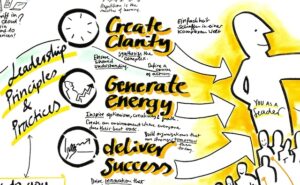
- Strategy and target picture development: Complex visions and strategies are translated into a “big picture” that provides orientation and creates identification.
- Change management: Visual support of change processes builds acceptance and makes it easier for teams to align.
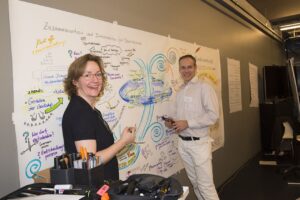
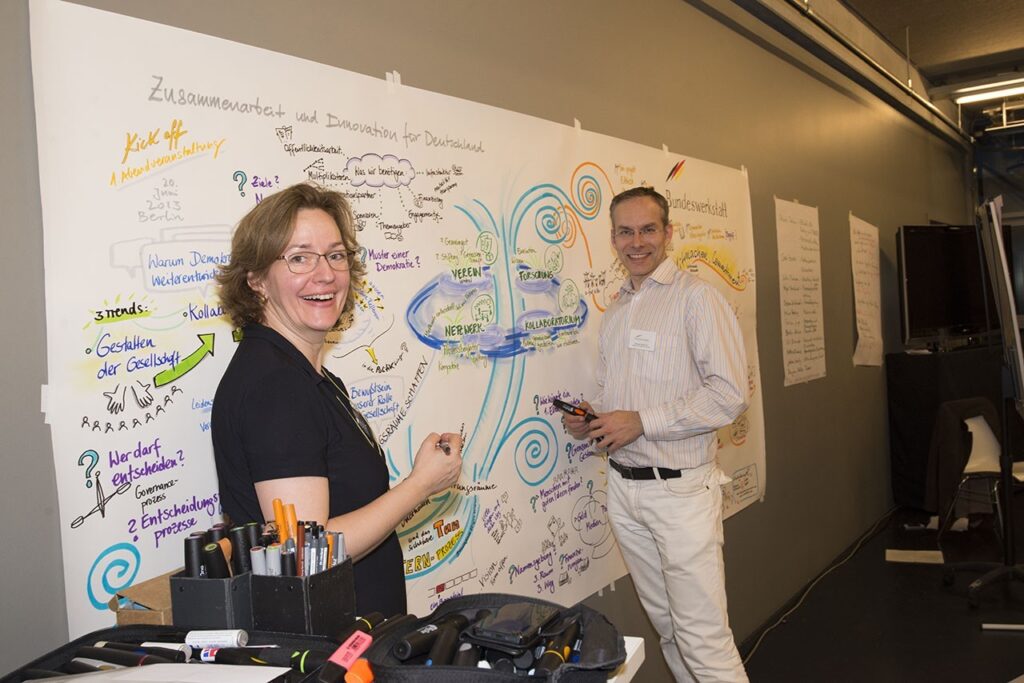
- Meetings and workshops: Graphic recording and visual facilitation make discussions easy to follow, actively engage participants, and capture results.
- Company culture: Values, guiding principles, and codes of conduct can be visualized, making them easier to live by every day.
- Knowledge management: Complex processes, workflows, or products can be made instantly graspable through explainer graphics or videos.
Especially in times of information overload and digitalization, visualization creates clarity, secures attention, and makes it possible to embed content in long-term memory. Companies that use visual communication strategically benefit from greater efficiency, better collaboration, and more innovative power.
Conclusion
Science confirms it: visualized communication works with the brain’s natural and effective image processing. Hand-drawn visualizations are gaining importance specifically against AI-driven alternatives, because they activate deeper, evolutionarily rooted emotional and cognitive mechanisms — a key reason to use them deliberately in a business context.
Turn strategy into real enthusiasm — with visualizations from VISUAL FACILITATORS!
VISUAL FACILITATORS: Your Experts for Sustainable, Visualized Corporate Communication
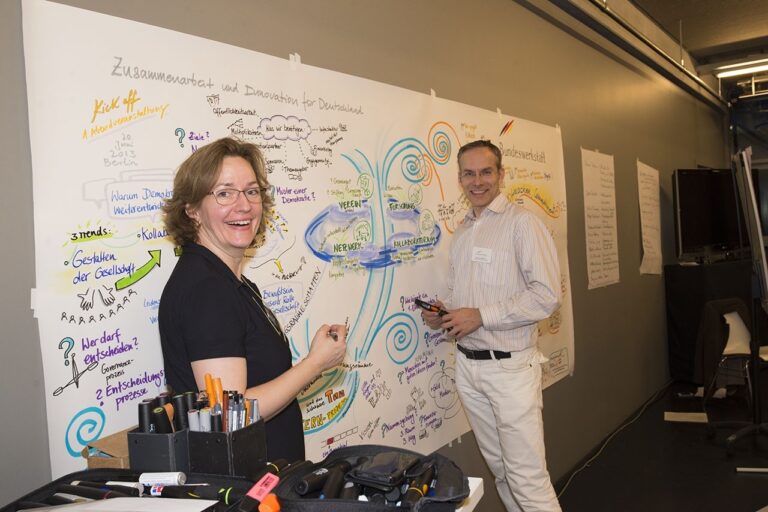
Looking for a way to communicate complex topics clearly, emotionally, and sustainably? Then you’ve come to the right place at VISUAL FACILITATORS. We are the pioneers of visualized process facilitation and strategy visualization in the German-speaking world.
Our team of more than 35 experienced visualizers, facilitators, and graphic recorders helps you communicate your business goals effectively and enable real transformation. We rely on hand-drawn visualizations, which scientific evidence shows have deeper emotional and cognitive impact — worldwide, online and on site.
Our services at a glance:
- Strategic visualization and target pictures: We translate visions and strategies into visual “big pictures” that provide orientation and create identification.
- Graphic recording: Live visualization of meetings, workshops, or events — for maximum traceability and engagement.
- Visual facilitation: Process facilitation and moderation using visual methods to guide teams through change and complexity.
With VISUAL FACILITATORS, you take your communication and company culture to a new level — clear, effective, and sustainable. Let’s visualize your goals together!
FAQ
Hand-drawn visualizations activate emotional and social brain regions more strongly than digital images. They feel more authentic, stay in memory longer, and foster empathy and engagement.
Visualization is ideal for strategy development, change management, meetings, company culture, and knowledge management. Wherever complexity needs to be reduced and people need to be involved, it delivers its full impact.
VISUAL FACILITATORS combines scientifically grounded methods with many years of hands-on experience. Our team relies on hand-drawn visualizations and supports companies in an individual, co-creative way through transformation processes.
References
Online Sources:
- University of Graz – Neurovision
- Neuromentaltraining – Visualisierung im Neuromentaltraining
- Spiegel Online – Hirnforschung: Forscher sehen Bilder in fremden Köpfen
- Speakture – Spiegelneuronen im Business
- Universität Hohenheim – Blick ins Gehirn: Glück ist unsichtbar
- Universität Gießen – Wahrnehmung von Bildern
- Deutschlandfunk Kultur – Studie: Echte Kunst in Museen stimuliert das Gehirn stärker als Nachdrucke
- Universität Giessen – Communicator
- Spektrum Lexikon: Visuelle Kommunikation
- DGPuK – Fachgruppe Visuelle Kommunikation
- Universität Tübingen – Visuelle Wissenschaftskommunikation in der Medizin
- Leibniz-Institut für Neurobiologie Magdeburg – Blick ins Gehirn: Glück ist unsichtbar
- Springer Professional – Handbuch Visuelle Kommunikationsforschung
- Focus Online – Hirnforschung: Forscher bringen Gedanken auf den Bildschirm
- Universität Wien – Menschen verspüren Emotionen auch bei computergenerierter Kunst
- Human Resources Manager – Das menschliche Gehirn arbeitet völlig anders
Academic sources:
MIT Neuroscience Research (2023): Our brain processes visual information in specialized regions of the visual cortex that have evolved over millions of years — long before the invention of text or AI.
Newton Neuro Research (2024): Hand-drawn visualizations activate additional brain regions for emotional processing and social bonding — the medial prefrontal cortex and amygdala show increased activity.
PMC Neuroscience Study (2023): When viewing hand-drawn images, the brain uses the same recognition mechanisms as for natural scenes, enabling deeper and more authentic processing.
RMCAD Neuroscience of Creativity Study (2024): While AI-generated images often appear “too perfect,” human imperfections in hand-drawn visualizations engage our evolutionarily rooted empathy centers.
News Medical Brain Function Study (2024): Combining visual perception and motor activity through drawing activates wide-ranging brain connections that are essential for learning and memory.
NSJ Memory Retention Study (2023): Hand-drawn visualizations promote active learning and memory formation more strongly than digital media, with up to 65% better information retention.
NYU Visual System Research (2023): In a world of digital overload, hand-made images function as “cognitive anchors” that engage our natural attention mechanisms.
PNAS Cognitive Response Study (2023): The brain shows increased activity in reward centers when viewing hand-made versus AI-generated visualizations.
Frontiers in Computational Neuroscience (2023): Artistic practice, such as visual facilitation, leads to more efficient neural processing in higher visual brain areas.
PMC Visual Processing Study (2023): The authenticity of hand-made visualizations activates brain regions for trust and social bonding more strongly than seemingly perfect digital images.