Vision, Team, Strategy.
Content
ToggleThree words that appear in almost every offsite request. The room is booked, the agenda is set, everyone is there. And yet, the day ends with a good feeling — but without any real change. Why does this happen? And what does a team need instead?
Imagine the following scenario: A university launches a strategy process. The request sounds clear: it is about alignment, the next few years, and a workshop involving many stakeholders. Big words, clearly formulated, with a seemingly straightforward brief.
But during the workshop, something else emerges. Not immediately and not openly, but after a few hours it becomes clear: before this group can decide where it wants to go, it first needs to clarify how it actually works together.
This is not an exception. It is the norm. And it is why we do not approach alignment as a presentation, but as a process supported by strategic visualization.
Why Strategy Workshops Often Miss the Real Issue
Teams talk about operational topics. Processes, tools, responsibilities, the project that keeps dragging on. These things are easy to discuss. They have clear boundaries, and no one has to reveal much about themselves.
The real tension almost always lies one level deeper. In questions such as: Where do we actually want to go? What role does each of us play in getting there? And do we trust one another to make it happen?
We see this constantly during initial briefings. A strategy day is requested. But when we ask what the team actually wants to achieve — often asking several times — another word eventually appears: trust. Belonging. Team building.
Behind the big words, there is often a very human need: to create a space where people can say what is really going on.
That is not a detour from the topic. It is the starting point.
As long as this level remains unspoken, it costs real money. Decisions are made three times and still not supported. Meetings go in circles because the actual issue is never put on the table. And a team may think it is divided when, in reality, it simply lacks a shared direction.
What is ultimately missing is a shared target visual that everyone can refer to.
Vision, Team, Strategy: Why Collaboration Is the Foundation
The common approach is: first we develop the strategy, then we take care of the culture.
In practice, it works the other way around.
The best foundation for a clear strategy is effective collaboration. When collaboration is healthy, strategy often emerges almost naturally because people can listen to one another, disagree constructively, and reach decisions together.
When collaboration is not working, even the best strategy process produces a document that nobody is willing to stand behind.
That is exactly why visualization in transformation processes is much more than illustration. You can learn more about how it works in our overview of Visual Facilitation.
We are currently seeing the same pattern in AI projects: the technology is available, but the impact fails to materialize because the people are not coming along. Our approach to this challenge is described here: AI Transformation: From AI Overload to Clarity.
An alignment process therefore begins with the question of how this team works together.
Not as a warm-up before the “real” work, but as an essential part of the work itself.
What a Shared Visual Can Do That Discussion Cannot
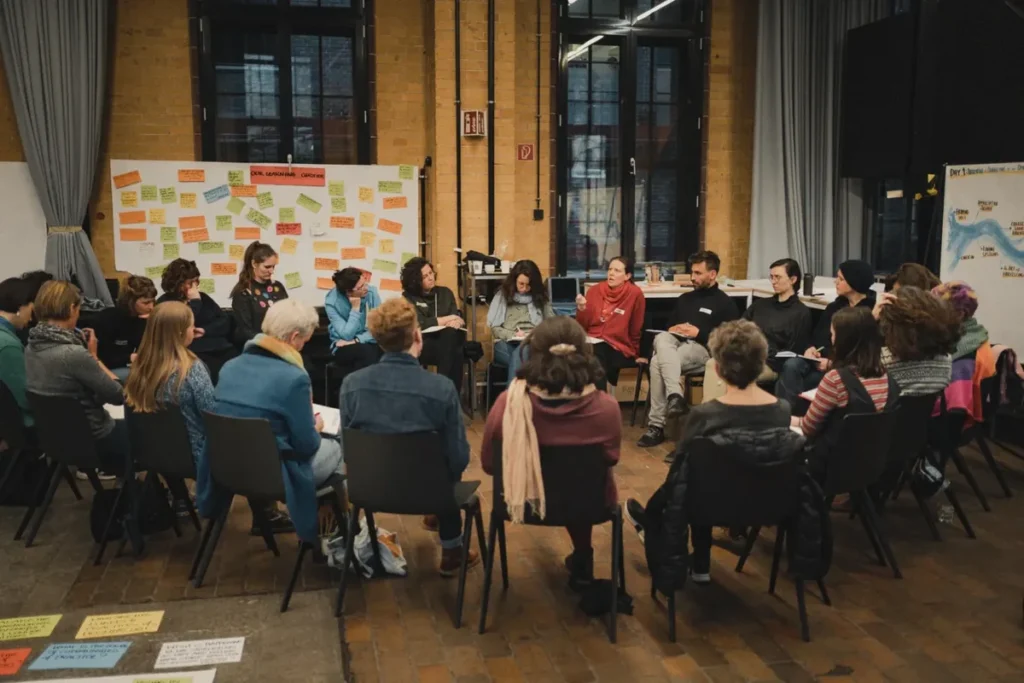
A conversation is linear. There can only ever be one contribution at a time, and each new contribution pushes the previous one out of mind. By the time the third person speaks, they are already competing with the fading memory of the first two.
A visual is simultaneous. Everything exists side by side and remains visible. This creates four effects that can be observed in almost every process.
Contradictions can exist side by side. In a discussion, one position often has to prevail over another. On paper, both can exist at the same time — visible and unresolved. And it is often precisely this tension that creates a third possibility that nobody had considered before.
Connections become visible. What belongs together, what is duplicated, what is actually just a deadline rather than a problem. A knot becomes a map, and a map is something a group can read together. Our article on visualized communication explains in more detail why this works.
People can see their own contribution. When someone finds their own words reflected on the page, they do not need to repeat them three times to make sure they have been heard. This saves time and builds trust without anyone having to explicitly talk about trust.
At the end, there is an artifact. The process does not disappear into a drawer. It stays on the wall and continues to work. A shared target visual keeps vision, team, and strategy visible at the same time — even weeks after the workshop. You can read more about why visible goals have a different impact than goals expressed only in words in our article on visualizing goals.
One distinction is crucial: this is process work, not image-making. Visualization is the means; the group process is the purpose. A beautiful visual that the group did not help create is decoration. A visual that emerges from the group becomes a shared target visual. We explain the approach behind this in more detail on our Visual Facilitation page.
And visualization has its limits. A visual does not make decisions. It makes visible what needs to be decided and captures what has been decided.
Leadership still has to make the decision.
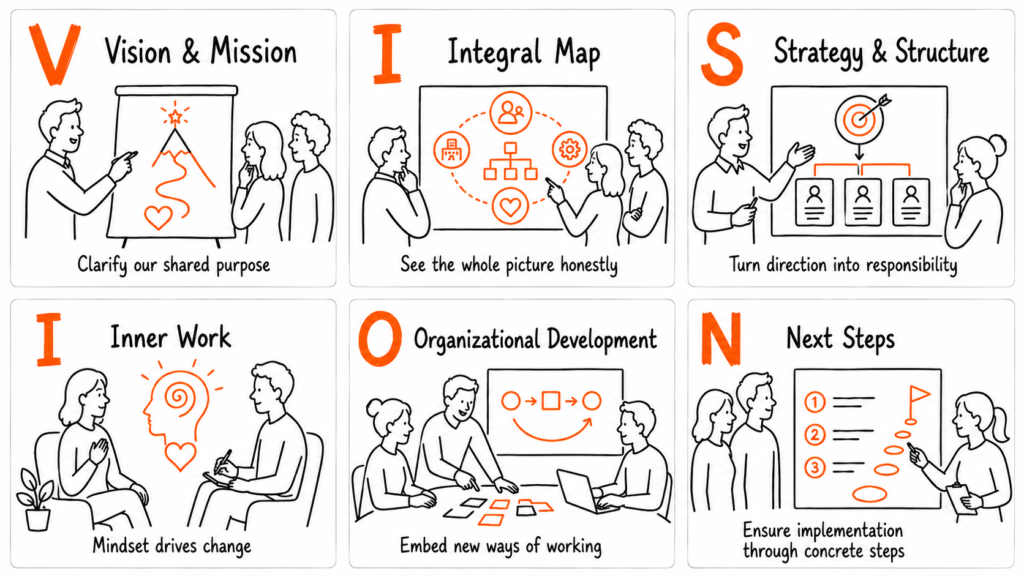
The VISION Process: A Framework for Alignment
Instead of working with a standard agenda, we use a framework that has evolved through many different processes. Six steps that build on one another and bring vision, team, and strategy into a meaningful sequence.
V for Vision, Values, Mission
The opening workshop. What does this team stand for? What does it want to achieve? What matters along the way?
The result is not a polished mission statement created in a writing exercise, but a shared direction that emerges from the group and is therefore supported by the people in it. You can find out what this step looks like as a standalone format here: Vision, Mission & Values.
I for Integral Map
The thinking framework, inspired by Ken Wilber and Spiral Dynamics. It distinguishes between four perspectives: individual and collective, inner and outer.
In practice, this means that a mindset problem is not mistaken for a structural problem — and vice versa.
S for Strategy
From the why to the how. Which paths lead toward the shared vision? What are the priorities? What will we deliberately not pursue?
This is where the big picture is translated into strategic directions that can be tested and acted upon.
I for Inner Work
Communication, mindset, and collaboration. This is the level that almost every initial briefing eventually leads to.
It deliberately comes after strategy, because by then it is clear what the quality of collaboration is actually needed for.
O for Organizational Development
Roles, structures, and responsibilities. Who does what, and with what decision-making authority?
Without this step, strategy remains an intention.
N for Next Steps
Who does what by when, and where will the work continue?
This step determines whether the process creates lasting impact or simply fades away.
Across all six steps, a visual result emerges: a shared picture that everyone has contributed to and in which everyone can recognize their own input.
When This Process Is the Wrong Format
Honesty is part of the process, so it is equally important to look at the other side.
The process requires time and genuine participation. If leadership has already made the decision and is simply looking for approval, an alignment process is the wrong tool. The group will notice within an hour.
If an acute conflict between individual people dominates the room, that conflict needs to be addressed first — in a different setting.
And if a team simply needs a clear documentation of its results, good documentation is enough. There is no need for a facilitated process.
There are many workshops that produce beautiful results and change nothing.
The difference lies in whether process design and visualization work together — and whether both are aligned around a clear objective.
How to Recognize What Your Team Needs Right Now
Three questions to ask before your next offsite:
Are you talking about processes and tools even though the real tension lies somewhere else?
Could everyone on the team explain in one sentence where you want to be in two years — and would you hear the same answer three times?
Are decisions being made only to be reopened again afterwards?
If you hesitate on two out of these three questions, you probably do not have a strategy problem.
You have an alignment problem.
Align Together
If vision, team, and strategy are pulling in different directions in your organization, we guide you through the VISION process — from vision to concrete next steps, combining facilitation and visualization in one integrated process.
You can find an overview of our approach to Facilitation for Change here.
Get in touch and we will use an initial conversation to clarify what you actually need.
Sometimes that turns out to be something different from what was originally requested.
Finding that out is the first step.
FAQ
A strategy workshop is a facilitated format in which a team clarifies its direction: where it wants to go, what its priorities are, and what it will deliberately not pursue.
It differs from a regular meeting through its preparation, the active involvement of all voices, and a documented outcome that the team can continue working with afterwards.
Visual Facilitation is an organizational development method in which group processes are made visible in real time. Contributions, connections, and decisions are captured as a shared visual that emerges on the wall.
The purpose is not documentation, but the effectiveness of the process: people can see their own contribution, recognize connections, and develop greater ownership of the outcome.
That depends on the size of the team and its starting point. An initial workshop on vision, values, and mission typically takes one to two days.
The full VISION process, including strategy, organizational development, and implementation support, usually unfolds over several months, with workshops and follow-up steps in between.
Both belong together. A sustainable strategy emerges when collaboration works, and collaboration becomes tangible when a team works toward a shared goal.
In our processes, both levels develop in parallel rather than being addressed one after the other.
About VISUAL FACILITATORS
For more than 20 years, we have supported strategy processes for medium-sized companies and consultancies across the DACH region. Our methods include Facilitation, Graphic Recording, Rich Pictures, and Visual Strategy Mapping.
Always live, always tailored to the specific context, always focused on measurable impact and the people involved.
And: we are pioneers in combining strategy activation with AI.